



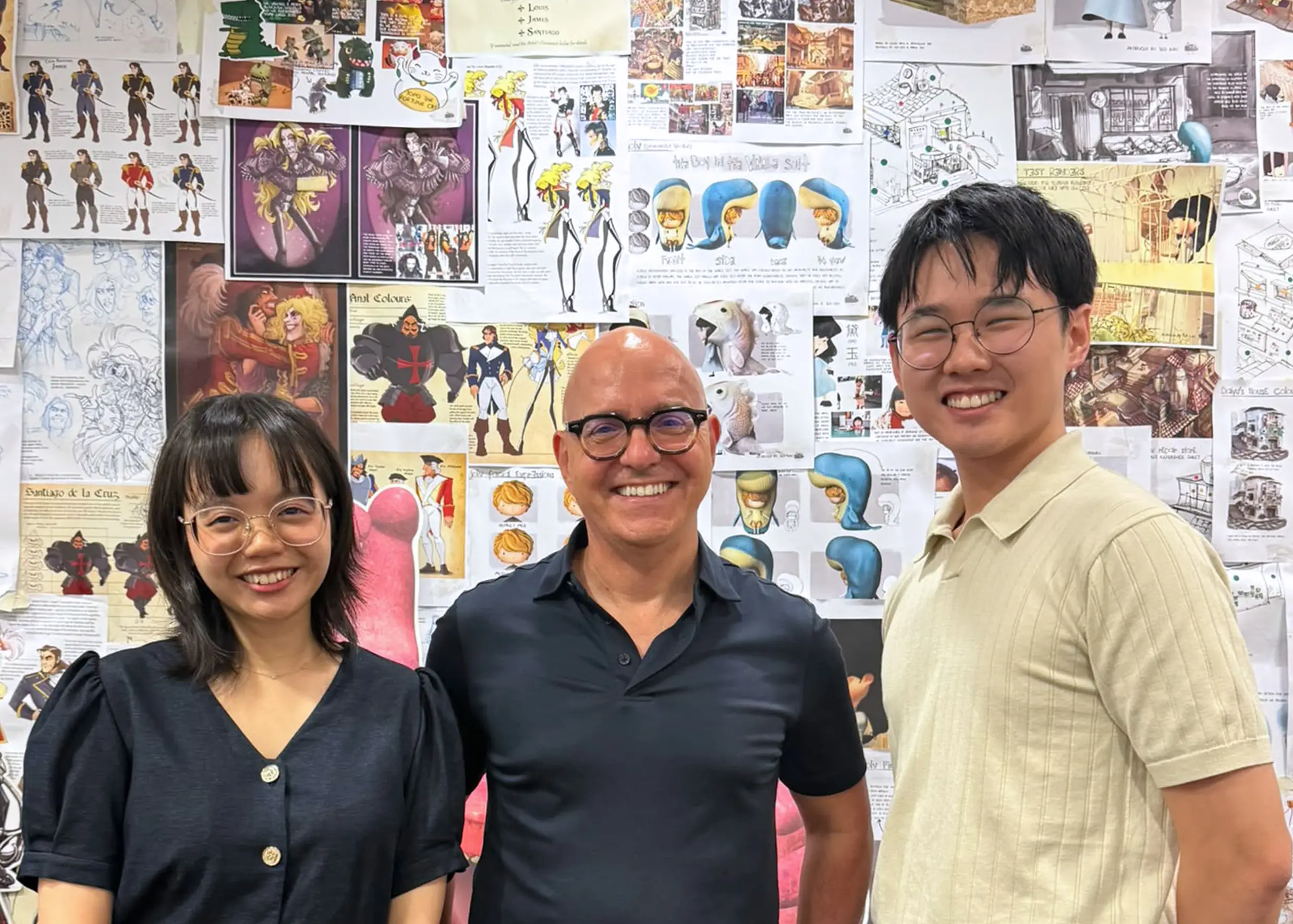
Director Kyle Balda (centre) with BA (Hons) Animation Art graduates Prim (left) and Austin Nah (right). Photo by BA (Hons) Animation Art alumna Poh Joanne.
In conversation with: Kyle Balda, director of Minions, Despicable Me 3 and The Sheep Detectives
8 Oct 2026
In June 2026, the Puttnam School of Film & Animation, in partnership with Cartoons Underground, hosted animation director Kyle Balda for a masterclass with students.
Balda is a director and storyteller working across animation and live action. He began his career as an animator at Industrial Light & Magic and Weta, before joining Pixar Animation Studios, contributing to films including Toy Story 2, A Bug’s Life, and Monsters, Inc.
Known for pairing large-scale entertainment with comedy and emotional sincerity, he directed Minions, Despicable Me 3, and Minions: The Rise of Gru before making the leap into live action with The Sheep Detectives.
BA (Hons) Animation Art, Class of 2026 graduates Austin Nah Yee Chern and Panisara Sutisukon (who also goes by Prim) had the opportunity to speak to Balda following the masterclass. They discussed Balda’s thoughts on how animation has evolved throughout his extensive animation career, how he navigated the transition from animation to live-action films, his favourite scene in The Sheep Detectives, as well as advice he would give to his younger self.
Hi Kyle, thank you for being here with us. We’re Austin and Prim.
Nice to meet you both!
Nice to meet you too. Our first question is, what does a script for Minion dialogue even look like? Is there someone who is in charge of writing all the banana jokes?
So, Pierre Coffin does all the voices for the Minions, and that includes writing them. He was my directing partner on a lot of the Minions projects like Minions and Despicable Me 3 and is also the director of the new film, Minions & Monsters.
In the early script, you got acting notes, but the writers didn’t actually bother writing in Minionese since Pierre already did that so well.
The main thing I can share from his process is that he’s just looking for real words. Funny words. Sometimes they’re from different languages. He’s half-Indonesian, so there’s even, like, ‘terima kasih’ which apparently is ‘thank you.’ Or they’ll say ‘mimi caso’ for ‘I’m going home’… Things like this—borrowing from other languages.
Mainly he’s looking for a music to the language that’s fun to listen to.
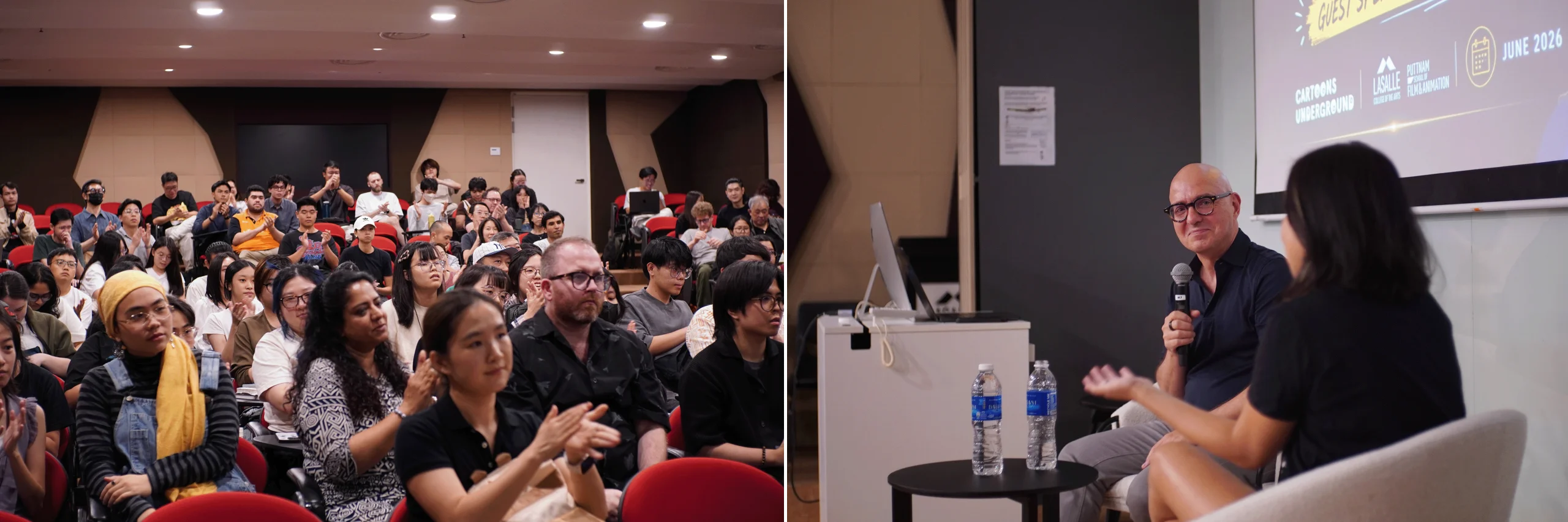
Students, alumni and the creative community tune in to Balda’s guest lecture at LASALLE College of the Arts. Photo by Poh Joanne.
Being in the industry for many years now—both in teaching, practice and directing—how has the medium of animation changed over your career, especially with new tools and technologies? What has stayed the same, and how does it impact your way of storytelling?
One of the big differences is going from 2D animation to 3D animation.
I like 3D animation since I don’t have to be limited to how well I can draw all these different angles. I do like to draw, but sculpting in clay and working with forms has always been more appealing to me.
I’ve tried doing a little bit of stop motion, and it’s left me with an extremely high respect for stop motion animators because I think it’s probably the hardest form of animation to do. It’s the most unforgiving because you have to work so linearly.
3D tools do make certain things not necessarily easier, but more possible, if you think about things like cloth simulators that the computer can handle really well. You do just nudge and guide, but still, you’re creating the real performance behind it.
And I think the things that haven’t changed—and that I don’t see really changing—are the basic principles that even go back to the Disney Animation: The Illusion of Life book that Frank Thomas and Ollie Johnston wrote way, way back in the day. Those give you the fundamentals of what movement and acting is.
You’re creating empathy for the characters, from the audience. You’re trying to get the audience to stop seeing them as a 3D puppet or an armature or a line drawing, and to care about what they want and start to relate to them.
Talking about how procedural tools help animation and how emotions are the key thing to look out for in connecting technology and storytelling—in The Sheep Detectives, we noticed that there’s a lot of emphasis towards touch and fur simulation between the CGI sheep and the actors. I want to know if there was any extra attention paid.
I mean, to help in a lot of the scenes, like when there was physical touch, there were very beautiful and elaborate puppets to give a real contact surface that would later be replaced with CG. In other cases the actors rehearsed with them first, then tried to perform without them there after. You want to believe that these sheep are there.
Giving something concrete to work with, I think, was really key. Framestore (our VFX studio) put so much attention into the fur feeling right: soft and fluffy. Add to that all the different textures that you get because there are so many different types of sheep.
More important than that was the eyelines. You know, when George (played by Hugh Jackman) is talking to Lily, he was given a puppet so that he could rehearse where her eyes are. He was so amazing at it that when you took the puppet out, he still maintained that eyeline. Then, when the animators brought the animated sheep in, they made sure that the scene worked to make them feel like they’re sharing the same space, or more importantly sharing in each others’ emotions.
You have experience in both animation and live-action. Filmmaking involves a lot of collaborative work. Which step in the process do you personally enjoy the most when working with others?
Well, with the live action process, there were a lot of new experiences with people who are really good at things different from animation. In animation, the director of photography role is shared between two people: the head of layout and the head of lighting. But George Steel, the director of photography for The Sheep Detectives, was thinking about all those things in unison with his sensibility and keen eye in terms of how to photograph something or what kind of lenses to use.
I did a lot of storyboarding to show him the intention behind what I was looking for. Then he would show me ways that we could execute that, but would additionally present different ideas.
With actors in animation, it’s again sort of split between different people. I would work with actors who did vocal performance, then work with animators on corporal performance. But working with Nicholas Braun and his performance of Officer Tim—he’s working off what’s motivating this character not in one scene alone but throughout the whole story. He and I came up with a bit of a backstory for his character. I think that’s really important for an actor to sink their teeth into.
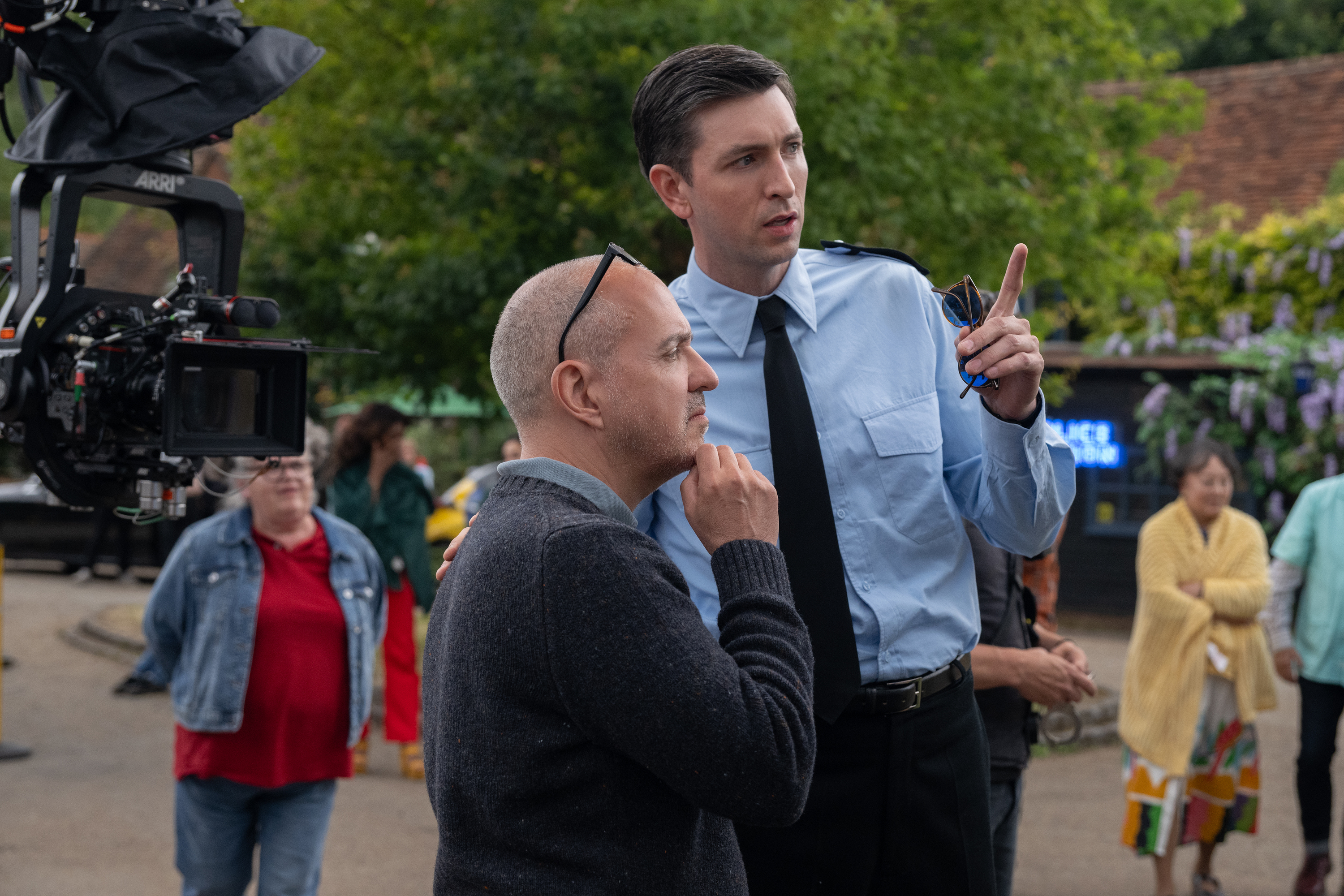
Balda and actor Nicholas Braun on the set of The Sheep Detectives. Image reprint from Sony Pictures Australia (@sonypicturesaus). Photo credit: Alex Bailey © 2026 Amazon Content Services LLC. All rights reserved.
Did the actors add something that you didn’t think about at first? Is it something like an improv session when you’re brainstorming with them?
It’s definitely welcome. I try to prepare as much material and direction as possible but you can’t be so heavy-handed that you’re telling them exactly what to do because, first of all, it’s just not a very collaborative way to work. You are missing out on so many opportunities.
You hire these actors because of what they bring: they have their own special way to become possessed by their characters. You are always going to get these gems and moments that you can’t create alone.
Never line-read an actor to tell them to say it how you hear it in your head, because you’d be missing out on ways you didn’t hear it in your head. That’s so much better, you know?
What’s the biggest risk you have faced when transitioning from animation to a live action-animation hybrid?
There’s a lot of things that you can’t control. You’re outside and you can’t control that it’s raining today. Or you need this shot to be sunny because it needs to fit with the other shots that you’ve already done for the scene but now the sun’s behind a cloud. A lot of it is how you pivot.
That’s where George Steel would be, like, “Don’t worry, I know how to make it look like it’s still sunny because of what we can do with the lights or how we photograph this.” He really put my mind at ease.
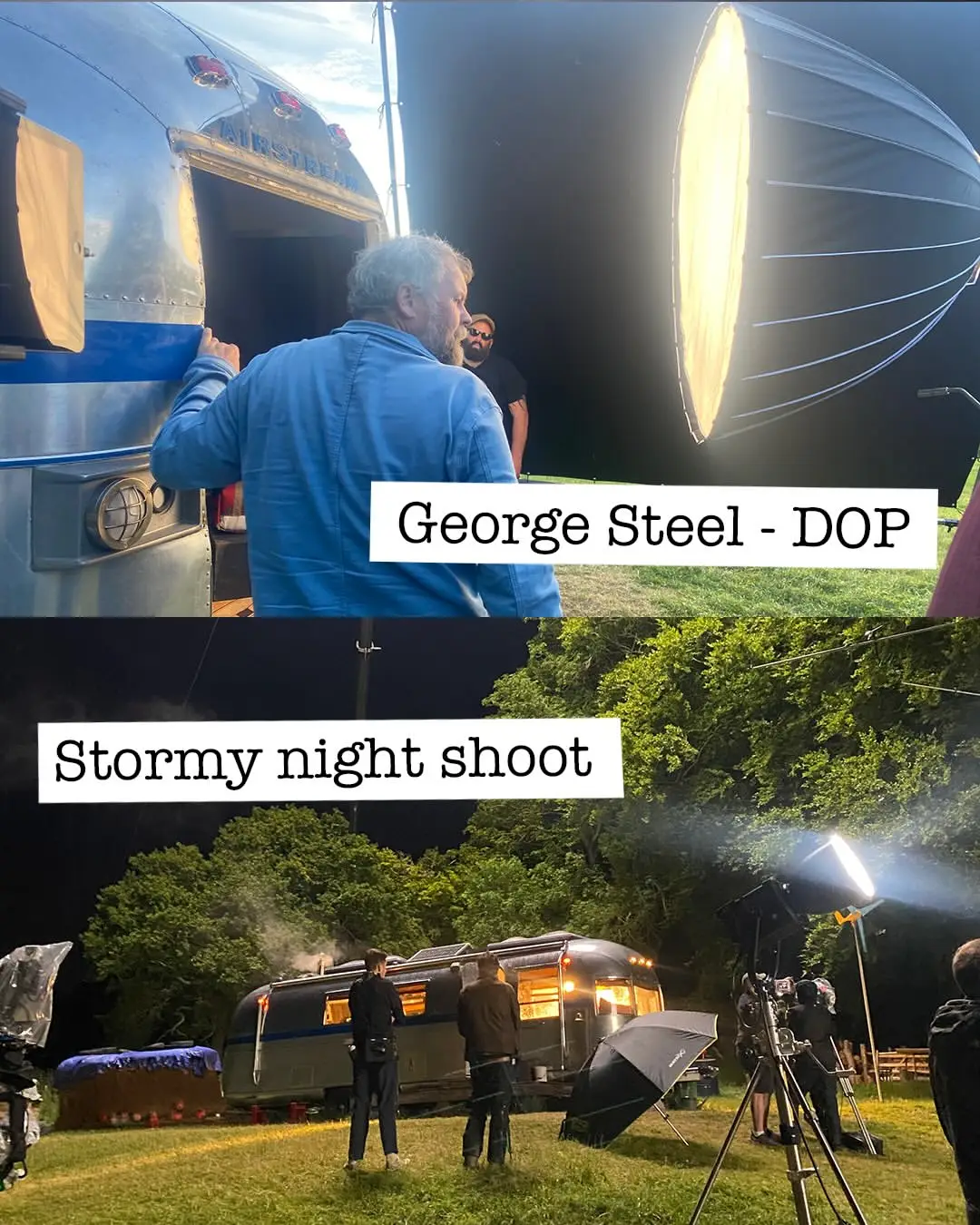
Balda’s behind-the-scenes photos featuring George Steel in his element. Image courtesy of Kyle Balda (@kylebalda_).
If it is completely raining, and you can’t do anything in-camera, that’s where Nick Laurence, our first assistant director, would say, “That’s okay, I’ve already accounted for this; we can shoot these days in indoor scenes and on the soundstage, and we can shift the schedule a bit.”
You’re surrounded by all these people who are so good at what they do that, as long as you’re able to express what the story needs and where the story wants to go, they’re there to help you realise that. That mitigates all the risk we talked about.
You speak a lot about The Sheep Detectives. Would that be the film that best captures the kind of director you have become?
One of my experiences when I read the script was, firstly, that it was really funny. I liked telling stories about the Minions, misfits who think they can solve problems that are way beyond what they’re skilled or qualified to do—and that’s definitely what the sheep are like.
The sheep are going to solve a murder mystery because they heard a couple of crime novels read to them at night! I really love that.
The Sheep Detectives is personal because of all that is shared about grief and memory. There’s this scene towards the end of the movie where Mopple is talking to Lily. It’s at night, they’re by the road, all the sheep have left. She’s processing the death of Sebastian, and Mopple talks about the value of remembering.
That has such personal resonance with me and the grief that I have felt from having lost loved ones. That’s where I could really project myself into this particular story.
Is that your favourite scene?
That’s my favourite scene. The way Chris O’Dowd—he plays Mopple—delivered those lines. Yeah. That’s definitely the one that gets me.
Many cry at that scene! In the age of AI, what are the kinds of films, stories and artworks you look towards that still have a sense of authenticity or a message that’s worth listening to? What should we do to preserve our artistic intent?
I mean, that’s a question I think we’re all asking. Because what’s difficult about that question is that any answer I give right now might not be the same six weeks from now; the terrain is changing so quickly.
Just really try to think authentically about the stories you want to tell. If there’s anything that would come of it, it would be that you find what your own style is and what your own voice is.
When I say ‘your own voice’, I don’t even necessarily mean in terms of writing. It can be visual too. It can be really tempting to look at what’s been done already and try to build off of that and copy that, but now these machines copy it better. So I think our feet are being held to the fire to really be original and do something new and try not to be derivative of something else.
I hope what this will mean is that audiences and their tastes will become even more particular in wanting new stories, new ways to tell stories, and hearing new voices.
Is there any story that gets you excited about doing what you do?
I find right now, if I look at things I’ve been attracted to, that it has been underdog stories of characters trying to sort of fail their way towards solving a problem, and the enjoyment that we feel watching them.
I love improvised family, found family, stories of a motley crew of characters who don’t belong anywhere, but belong together. That’s the one thing that they share. These are the things I always find that I come back to. It wasn’t even a conscious choice.
I do hope, though, that as time goes on, different themes arise that attract me, because it would be an indication to myself that I am growing and changing. That’s always welcome.
Last question: is there any advice you’d give to your younger self before embarking into the animation industry? We’re newly graduated as well, so we would like to know.
It’s funny because I started just wanting to be picked by a studio to get a job and feel validated, as well as the practicality of paying rent and wanting to earn a paycheck and things like that.
It was over many, many years that I started to become more of a storyteller than only contributing to the telling of a story. I think if there was anything that I would go back to say to my younger self, I would say to start that change in perspective earlier and to not only think about the means to the end.
For a lot of students, when you’re coming out of school, there’s this feeling of wanting to find your place. Part of it is the search for the confidence you receive when you are hired by somebody—for somebody to say: you’re good enough, you can do this.
But you should try to find your own courage in your own voice as soon as you can. Try to break away and tell your own stories, make your own artwork, whatever that is.
Even if it’s not storytelling—although I think everything is storytelling in some ways—just start taking risks earlier and do not become too complacent with just contributing to something.
There are great opportunities when you’re working at a studio or on a bigger project, because you can learn from a lot of really experienced people. That experience really then becomes more valuable when you start to apply it to making your own thing.
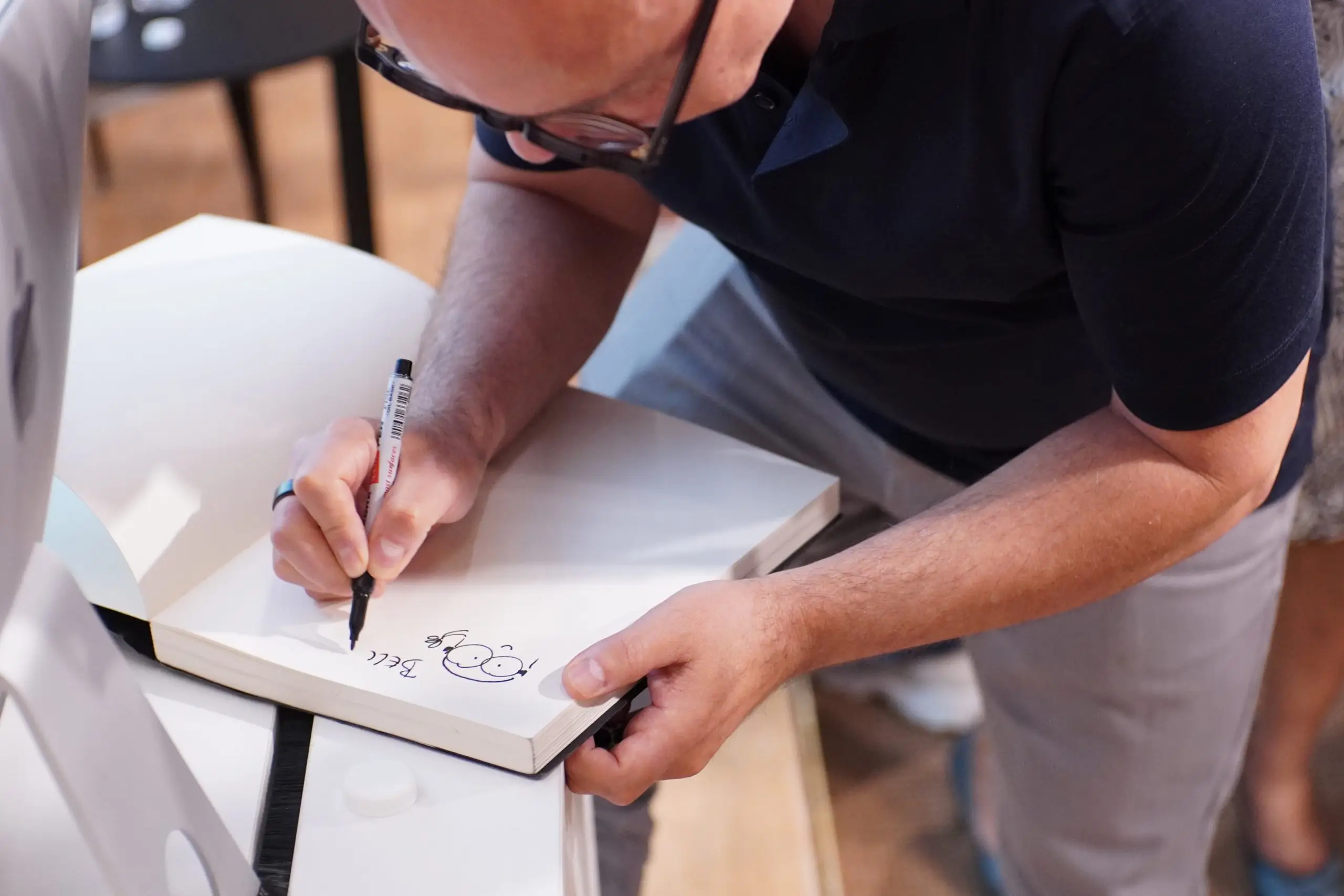
Balda autographing a student’s book. Photo by Poh Joanne.
Thank you very much for your time, we really appreciate it, and again it’s been a pleasure meeting you!
Yeah! Likewise.
This interview has been edited and condensed for clarity.
Related stories
What to expect in LASALLE
Global Creative Dialogues: Cross-university collaborations and knowledge exchange in fashion, illustration and technology
6 Oct 2026
This article was originally written for and published in HKBU AVA Magazine #15 (September 2026) and is reproduced with permission. From August to November 2025, “Stories From Our Wardrobe” brought …

In conversation with
In conversation with: Kamila Andini on filmmaking as a record of personal discovery
4 Sep 2026
Kamila Andini is one of Southeast Asia’s most distinctive voices. From her acclaimed debut feature The Mirror Never Lies (2011), The Seen Unseen (2017), Yuni (2021) and Before, Now & …
What to expect in LASALLE
What to expect in LASALLE: BA (Hons) Music’s Ngiam Teo on composing for games, film and his own original epic
12 Aug 2026
For his final year project, Class of 2026 graduate Ngiam Teo presented Fleeting Worlds: For The Dawn, which tells the story of Zinnia, an ordinary girl who initially rejects her …
Trip report
Memories of Museums, Matcha and mono no aware (物の哀れ): MA Asian Art Histories 2026 study trip to Fukuoka, Japan
4 Aug 2026
By Kendall Fosse and Aparupa Saha At the beginning of the academic year, when the 2026 cohort of LASALLE’s MA Asian Art Histories programme was told about a planned study …